Reclaiming Digital Pedagogy: An Executive Overview
Introduction
Digital learning environments are not neutral containers for content. They are social, epistemic and political infrastructures that shape what teaching and learning may become. The five blog series collected on this site form a single intellectual project grounded in this conviction.
Each series focuses on a distinct concern in digital education, yet they converge on a shared argument. Educators who wish to cultivate autonomy, agency and intellectually meaningful learning must understand the forces that configure digital environments and must actively reclaim the pedagogical ground. This executive overview introduces the series as a coherent whole.
The core problem across the series
A shared diagnosis runs through all five series. Higher education increasingly relies on tightly integrated platforms that promise efficiency, consistency and scalability. These systems encode managerial assumptions about good teaching, evidence of learning and compliant academic practice.
Platform defaults exert a gravitational pull on both educators and students. Assessment becomes risk-managed rather than intellectually ambitious. Course design narrows to what the LMS supports. AI, presented as a productivity tool, intensifies these tendencies by normalising automation and further reducing space for human judgement.
Across the series, the core problem is the flattening of pedagogical imagination. The central question is how educators can resist this narrowing and reassert meaningful pedagogical agency in digital contexts.
Series One: Reclaiming Digital Pedagogy
Posts
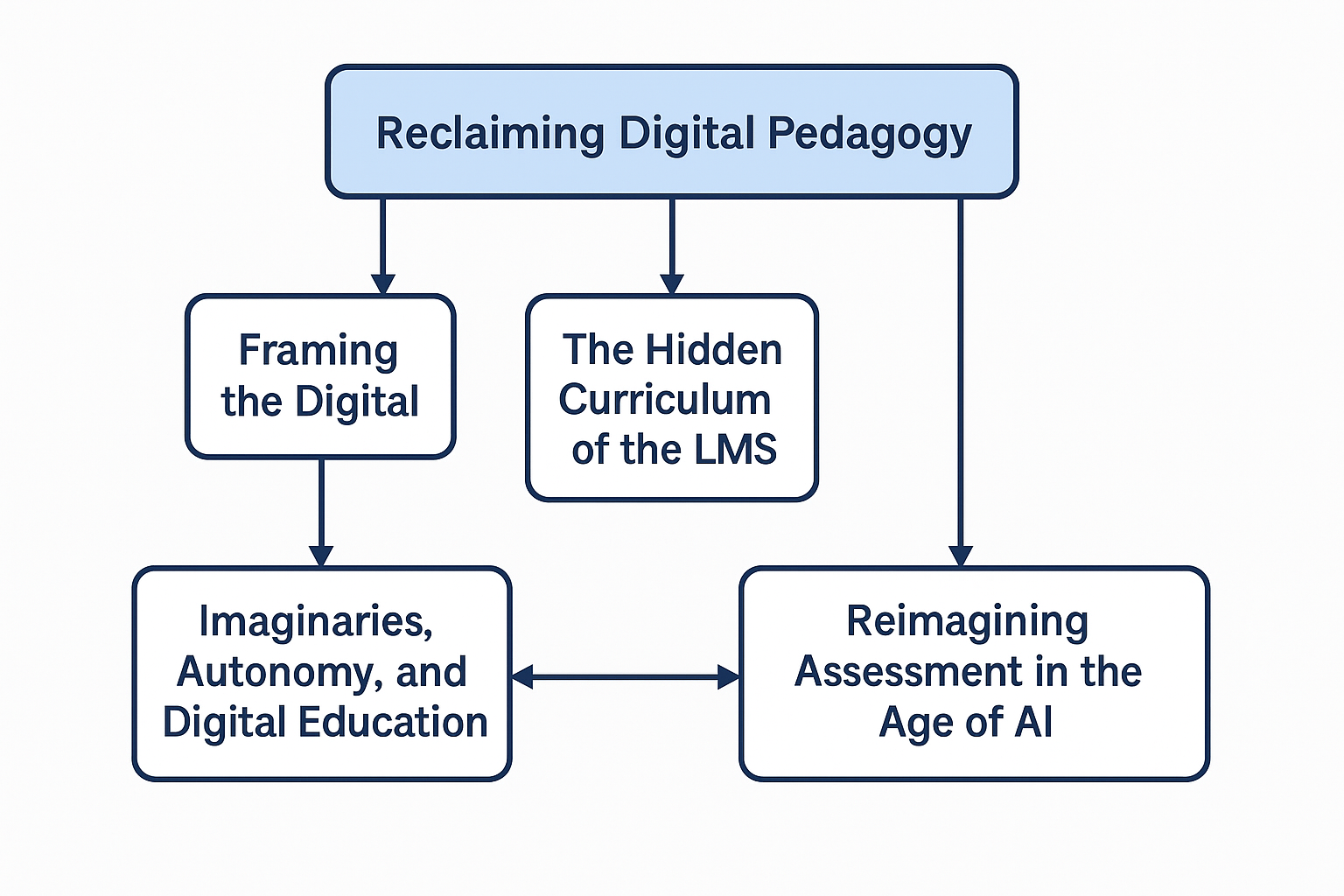
- Framing the Digital: Why Pedagogy Must Come Before Platform
- The Hidden Curriculum of the LMS
- AI, Assessment, and the Automation of Judgement
- Digital Policy is Pedagogy: Why Educators Must Engage
- Critical Infrastructure: Reimagining the Digital University
- Reclaiming Pedagogy in a Platformed World - A Manifesto
This series argues that pedagogy must come before platform. It shows how digital practice easily becomes oriented around what the system can do rather than what learners need. Interfaces embed institutional logics that can work against values such as autonomy, inquiry and relational learning.
Together, these posts frame the digital environment itself as a pedagogical site. They examine the hidden curriculum of the LMS, the politics of AI and assessment, the role of institutional digital policy, and the broader infrastructural conditions that shape practice. Understanding how platform design and governance shape behaviour is essential if educators are to work against limiting tendencies and reclaim pedagogical agency.
Series Two: The Imaginary Institution of Education
Posts
- Imagining Otherwise: Castoriadis, Radical Imagination, and the Crisis of Educational Futures
- Autonomy and the Educated Subject: Rethinking Learning Beyond Instrumentality
- Institution and Imaginary - How Educational Technology Reproduces the Social-Historical
- Critique as Creation - From Technological Solutionism to Political Pedagogy
- Time, History, and the Institution of Learning - Beyond the Eternal Present of EdTech
- Reimagining the Digital University - A Call for Democratic Pedagogical Institutions
This series turns to the imaginary as a way of understanding digital education. Drawing particularly on Castoriadis, it explores how radical imagination, institutional forms and historical time shape what is thinkable within universities.
The posts argue that educational technologies participate in reproducing the existing social-historical order, often narrowing our sense of what education could be. Critique therefore has to be creative. It must open up alternative futures for the digital university and reposition pedagogy as a political and imaginative act rather than a technical implementation.
Series Three: Pedagogy and the Social Imaginary
Posts
- The Moral Background of Education: Introducing the Social Imaginary
- The Autonomous Individual Learner: Taylor, EdTech, and the Buffered Self
- Merit, Measurement, and Moral Order: The Market Imaginary in Education
- The Public Sphere and the Digital University: Imaginaries of Voice and Visibility
- Strong Evaluation in a Flat World: Resisting the Neutrality of Platforms
- Rewriting the Imaginary: Educators as Moral Agents of Reinstitution
Building on the previous series, these posts work more closely with Charles Taylor and related thinkers to examine how moral backgrounds, market logics and conceptions of the self are embedded in digital education.
The series shows how imaginaries of meritocracy, neutrality and individual achievement are encoded in platforms and policies. It argues that educators must engage in strong evaluation, explicitly articulating the goods that matter in education, and must see themselves as moral agents capable of rewriting the imaginary that structures their practice.
Series Four: Institutions, Imaginaries, and the Common Good
Posts
- Education as Polis - Reclaiming the Public Dimension of Learning
- Imaginaries of the Common Good - From Market Logic to Democratic Renewal
- Autonomy, Agency, and the Educated Subject - Beyond the Individual Learner
- Institution, Technology, and the Reproduction of Society
- Plurality, Natality, and the Promise of Education
- Reclaiming Education as a Democratic Institution - A Manifesto for the Common Good
This series shifts the focus to institutions and the common good. It treats education as a kind of polis, a shared space of appearance where plurality and natality matter. Against a narrow market imaginary, the posts argue for democratic renewal, collective agency and a richer understanding of autonomy and the educated subject.
Technology is read as part of the institutional fabric through which societies reproduce themselves. The series concludes with a manifesto that calls for reclaiming education as a democratic institution oriented to the common good rather than to narrow measures of performance.
Series Five: Enacting Digital Pedagogy
Posts
- Teaching Against the Interface
- Reimagining Assessment in Practice
- Building Commons in Digital Learning
- Time, Care, and Educational Infrastructure
- Enacting Digital Pedagogy: Pedagogy as World-Making
- From Imaginaries to Action - Part VI: A Manifesto for Critical Digital Practice
The final series moves from critique to action. It begins with teaching against the interface, demonstrating how educators can work tactically within platform constraints. It revisits assessment in a practical key, asking how design can foreground process, judgement and intellectual presence in the age of AI.
The series then turns to building commons in digital learning, to questions of time and care in educational infrastructure, and to pedagogy as world-making. It culminates in a manifesto that articulates principles for critical digital practice and invites educators to enact alternative imaginaries in their day-to-day work.
Cross-cutting themes
Although each series has its own emphasis, several themes connect them:
- Educator agency is central and must be defended against narrowing tendencies in digital platforms.
- Institutional cultures shape digital practice as powerfully as technologies do.
- Platform design has political and ethical consequences that require critical scrutiny.
- Federated and open technologies provide alternatives that align more closely with democratic pedagogical values.
- Student autonomy is a core pedagogical and moral imperative rather than a peripheral concern.
- AI reveals the fragility of inherited practices and makes the work of reimagining assessment and pedagogy more urgent.
What the full project argues
Taken together, the five series argue for a pedagogical turn that resists technical determinism and foregrounds autonomy, relational learning and democratic practice. They advocate for digital infrastructures that serve the public good, for assessment that values judgement and presence, and for institutional arrangements that expand rather than constrain pedagogical possibility.
AI intensifies the urgency of this work by exposing the limits of surface-level assessment and compliance-driven design.
A way forward
Reclaiming digital pedagogy requires action at multiple levels:
- Educators who question platform defaults and design for autonomy and dialogue.
- Institutions that treat digital infrastructure as an ethical and strategic concern rather than a procurement exercise.
- Technologists who collaborate with educators to expand, not reduce, pedagogical imagination.
- A sector that treats digital education as a common good and invests in open, federated and democratic infrastructures.
Conclusion
This executive overview presents the five series as a coherent argument for reclaiming pedagogy in digital higher education. Each series can be read individually, but together they offer a comprehensive analysis of the politics of digital learning and the possibilities that emerge when educators refuse to accept platform defaults as inevitable.
Readers seeking deeper engagement will find throughout the series a commitment to connecting critique with practice, grounded in a vision of more humane and imaginative digital education.